

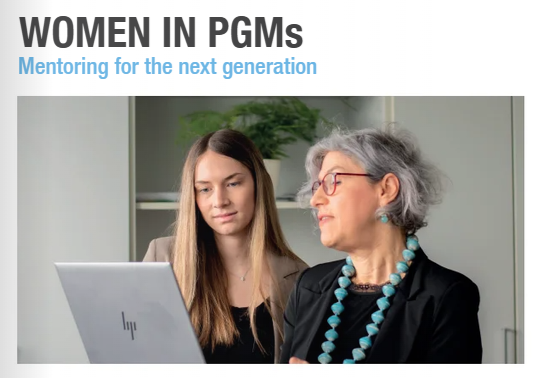
The world of platinum group metals is global, technologically advanced and of strategic importance for future-oriented sectors such as electric mobility and hydrogen. At the same time, the industry has historically been dominated by men.
This is precisely where the “Women in PGMs” initiative comes in. The international network connects women across the entire PGM value chain – from mining through trading and processing to recycling and research. The focus is not only on professional exchange, but above all on the question: How can talent be identified and specifically nurtured?
Mentoring as a cultural tool
A core component of the initiative is the mentoring programme launched in 2023. It brings together experienced female industry representatives with up-and-coming talent – in a structured, committed manner and over a clearly defined period. This is not about casual conversations, but genuine development work: regular meetings, concrete objectives and professional support ensure reliability.
But the real added value runs deeper. Here, mentoring is not seen as a hierarchical model, but as a dialogue between generations, cultures and worlds of experience. It creates space for reflection, orientation and personal self-assessment – particularly in an industry undergoing significant technological and regulatory change.
Commitment born of conviction
Hensel Recycling is also part of this network. Anna Marchisio, Business Development Manager for Critical Raw Materials Recycling, has been involved as a mentor since the beginning. She has so far supported four mentees from different countries and fields of work – ranging from retail to mining.
For her, mentoring is more than just passing on knowledge: “For me, mentoring is not a one-way street. Of course I pass on my experience – but I learn just as much in return. New perspectives, different cultural backgrounds and fresh insights enrich my own work. In a way, it is always reverse mentoring too.”
It is precisely this shift in perspective that makes the programme a cultural asset – not only for the participants, but also for the companies behind it. Topics such as leadership responsibility, international mobility or balancing professional ambitions with personal life choices are discussed openly. This builds trust – and boosts self-confidence.
International diversity as a strength
Over 500 women are now involved in the network, with active chapters in South Africa, Europe, North America and China. The participants represent the entire spectrum of the PGM industry – from producers and traders to recycling companies.
This diversity is not a side effect, but the very core of the network. Different market dynamics, cultural backgrounds and professional experiences come together – broadening participants’ horizons. Particularly in an industry that thrives on innovation and transformation, diversity thus becomes a strategic factor.
People & Culture as a key issue for the future
Women in PGMs symbolises a shift within the industry: talent development, international networking and cultural openness are increasingly seen as integral to corporate responsibility.
For companies, this means more than mere representation. It is about long-term competitiveness. Those wishing to attract and retain skilled workers must offer prospects – both professionally and personally. The mentoring programme demonstrates how targeted support can unlock potential. It creates visibility, strengthens individual career paths and builds resilient international connections.
In a global industry where technological excellence is crucial, this highlights another key factor for success: people. After all, sustainable development does not arise solely from innovation – but from the culture that makes it possible.
____
Published in – Hensel Recycling HenRy Insight – EN-HenRy2026